chitika1

chitika

Showing posts with label robots. Show all posts

Monday, October 11, 2010

Is Google Making Robotic Car?: And Driven 225,000km by itself

Robotic Car Of Google


Mulit-billion-dollar international technology company, Google, has been secretly working away on developing robotic cars capable of driving themselves. As Google is only for internet before we know this. You know all about Google that Google was developed for only internet. But now it is launching too many projects and services by the great stuff. I don't know what has Google in it's mind? Before some time as I published my previous article describing new function on maps. But Now I am talking about Google is going to make  business?

However Google was working on this project for last year. But as this was secret that was no information has been leaked by Google. But now Google is giving some information about its project. Google is releasing information what the company has been up to in the last year or so and where it’s currently at.

Published on it's Blog  Google has revealed it has not only begun to forge the way in robotic car development, but it’s already driven a small fleet of automated Toyota Prius’ around parts of California for a total of 225,000km on public roads. The interesting thing is most of us weren’t even aware it was happening.


Here I will going to show one video that is published on YouTube. This video was published before I think one year. And for that Google has said that that is only for google images and for maps. But now it is seen that it is completely robotic car that was made  by technicians of Google. 

Actually Google has made this car as technology to help people to stop accident and manage traffic. There is great thought of Google. As It's for Google images, maps, And other hand it's also for to help people to prevent accident.Google also says that this technology has the potential to cut road-related fatalities by as much as half if it were applied to the infrastructure.

Before seeing look what Google says about it's Robotic car and about it's thoughts on it's innovative ideas.


"Larry and Sergey founded Google because they wanted to help solve really big problems using technology. And one of the big problems we’re working on today is car safety and efficiency. our automated cars use video cameras, radar sensors and a laser range finder to “see” other traffic, as well as detailed maps (which we collect using manually driven vehicles) to navigate the road ahead. This is all made possible by Google’s data centers, which can process the enormous amounts of information gathered by our cars when mapping their terrain."


that's straight means you can see that Google is going to make all latest technology with it's services and make it different and the best for ever. and Also it's straight profit is to people like us on the road as robotic car to prevent Accident.

"We’ve always been optimistic about technology’s ability to advance society, which is why we have pushed so hard to improve the capabilities of self-driving cars beyond where they are today. While this project is very much in the experimental stage, it provides a glimpse of what transportation might look like in the future thanks to advanced computer science. And that future is very exciting."

I don't have to say anything about how google is thinking as all part of it's business and make good interact with users of it. Indirectly it is making it's position to people who is not using internet. Before some time people who don't use Internet they didn't know anything about Google but new service launching of Google as making it to diiferent all have to know about GOogle.!

Now Check Out this video of robotic car by Google:

Sunday, September 19, 2010

Pressure-sensitive crystalline semiconductor used to create artificial skin

Engineers at the University of California, Berkeley, have developed a pressure-sensitive electronic material from semiconductor nanowires that will help overcome a key challenge in robotics: adapting the amount of force needed to hold and manipulate a wide range of objects. The artificial skin has been dubbed "e-skin" and the researchers say it is the first such material made out of inorganic single crystalline semiconductors.

"The idea is to have a material that functions like the human skin, which means incorporating the ability to feel and touch objects," said Ali Javey, head of the UC Berkeley research team developing the artificial skin.

"Humans generally know how to hold a fragile egg without breaking it," said Javey. "If we ever wanted a robot that could unload the dishes, for instance, we'd want to make sure it doesn't break the wine glasses in the process. But we'd also want the robot to be able to grip a stock pot without dropping it."

Previous attempts to develop an artificial skin relied upon organic materials because they are flexible and easier to process. "The problem is that organic materials are poor semiconductors, which means electronic devices made out of them would often require high voltages to operate the circuitry," said Javey. "Inorganic materials, such as crystalline silicon, on the other hand, have excellent electrical properties and can operate on low power. They are also more chemically stable. But historically, they have been inflexible and easy to crack. In this regard, works by various groups, including ours, have recently shown that miniaturized strips or wires of inorganics can be made highly flexible - ideal for high performance, mechanically bendable electronics and sensors."

The UC Berkeley engineers utilized an innovative fabrication technique where the nanowires are "grown" on a cylindrical drum and then rolled onto a sticky substrate. The substrate used was a polyimide film, but the researchers said the technique can work with a variety of materials, including other plastics, paper or glass. As the drum rolled, the nanowires were deposited, or "printed," onto the substrate in an orderly fashion, forming the basis from which thin, flexible sheets of electronic materials could be built. 

For the e-skin, the engineers printed the nanowires onto an 18-by-19 pixel square matrix measuring 7 centimeters on each side. Each pixel contained a transistor made up of hundreds of semiconductor nanowires. Nanowire transistors were then integrated with a pressure sensitive rubber on top to provide the sensing functionality. The matrix required less than 5 volts of power to operate and maintained its robustness after being subjected to more than 2,000 bending cycles. The researchers demonstrated the ability of the e-skin to detect pressure from 0 to 15 kilopascals, a range comparable to the force used for such daily activities as typing on a keyboard or holding an object.

Robots taught to deceive

Researchers from the Georgia Institute of Technology have developed algorithms that allow a robot to determine whether it should deceive a human or other intelligent machine and which techniques to use for the best deceptive strategy. The new work, published in the International Journal of Social Robotics, is believed to be the first detailed examination of robot deception.

Georgia Tech's Alan Wagner (right) says that robots capable of deception will likely be valuable for military and search and rescue operations. A search and rescue robot may need to deceive in order to calm or receive cooperation from a panicking victim. Robots on the battlefield with the power of deception will be able to successfully hide and mislead the enemy to keep themselves and valuable information safe.

Wagner and his co-researchers focused on the actions, beliefs and communications of a robot attempting to hide from another robot to develop programs that successfully produced deceptive behavior. Their first step was to teach the deceiving robot how to recognize a situation that warranted the use of deception. The researchers used interdependence theory and game theory to develop algorithms that tested the value of deception in a specific situation. A situation had to satisfy two key conditions to warrant deception -- there must be conflict between the deceiving robot and the seeker, and the deceiver must benefit from the deception.

Once a situation was deemed to warrant deception, the robot carried out a deceptive act by providing a false communication to benefit itself. The technique developed by the Georgia Tech researchers based a robot's deceptive action selection on its understanding of the individual robot it was attempting to deceive.

To test their algorithms, the researchers ran 20 hide-and-seek experiments with two autonomous robots. Colored markers were lined up along three potential pathways to locations where the robot could hide. The hider robot randomly selected a hiding location from the three location choices and moved toward that location, knocking down colored markers along the way. Once it reached a point past the markers, the robot changed course and hid in one of the other two locations. The presence or absence of standing markers indicated the hider's location to the seeker robot.

"The hider's set of false communications was defined by selecting a pattern of knocked over markers that indicated a false hiding position in an attempt to say, for example, that it was going to the right and then actually go to the left," explained Wagner.

The hider robots were able to deceive the seeker robots in 75 percent of the trials, with the failed experiments resulting from the hiding robot's inability to knock over the correct markers to produce the desired deceptive communication.

"The experimental results weren't perfect, but they demonstrated the learning and use of deception signals by real robots in a noisy environment," said Wagner. "The results were also a preliminary indication that the techniques and algorithms described in the paper could be used to successfully produce deceptive behavior in a robot."

The researchers are not unaware of the ethical issues that robotic deception creates. "We have been concerned from the very beginning with the ethical implications related to the creation of robots capable of deception and we understand that there are beneficial and deleterious aspects," explained co-researcher Ronald Arkin. "We strongly encourage discussion about the appropriateness of deceptive robots to determine what, if any, regulations or guidelines should constrain the development of these systems."

Thursday, September 16, 2010

Saturday, September 4, 2010

man or robot:Cyberdyne is coming with the world latest technology of robot


A Japanese Company Cyberdyne 


is coming whit the world latest technology of robot. It is very interested to know that really it is very interesting device because it helps to disable people, we can know it the name of this device, HAL or Hybrid Assistive limb, it is a very unimaginative robotic suit for all robotic fans who are waiting for something special in this robotic field. This unimaginative robotic suit is very helpful for all disable and elderly people because it has the quality of reading brain signal and has far reaching benefits. This technology is the latest technology for the robotic field and it based on the computerized technology which has come with sensors device. In this robotic suit, reads brain signal and directs limb movement always comes through the skin which helps to disable and elderly people for moving around. It is very easy to use for them because it is worn as a belt around the waist and operated by a22 pound battery.
The Japanese company has come with this product of the cost of $1,500 for a monthly rental fee. Why we are saying so much about this interesting product because it really works so well how, first it has a sensor whish help for capture the brain signal and it goes thorough mechanical legs braces strapped to the thighs and knees. Which then provide robotic help to disable people where they want to move any where? Really this product are very useful and it will be very useful and helpful for medical line where a lot of disable people who can not do any thing whit out any help so Japanese are really such a god for them who are bringing this helpful robotic suit.

Friday, August 27, 2010

Humanoid Robot !

'Sci/Tech' Archives

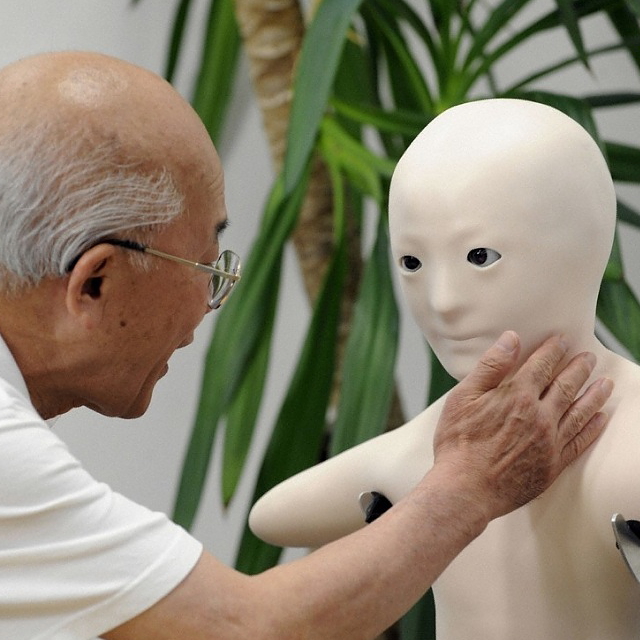
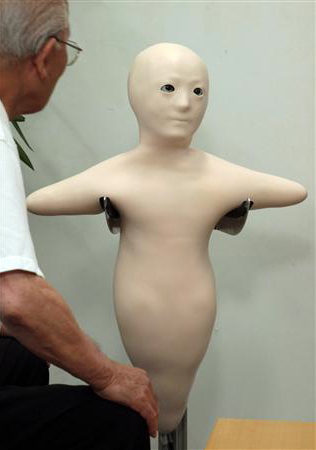
Telenoid R1 minimalist humanoid robot

Researchers from Osaka University have teamed up with the Advanced Telecommunications Research Institute (ATR) to develop a minimalist humanoid robot that recreates the physical presence of a remote user.
Telenoid humanoid robot --
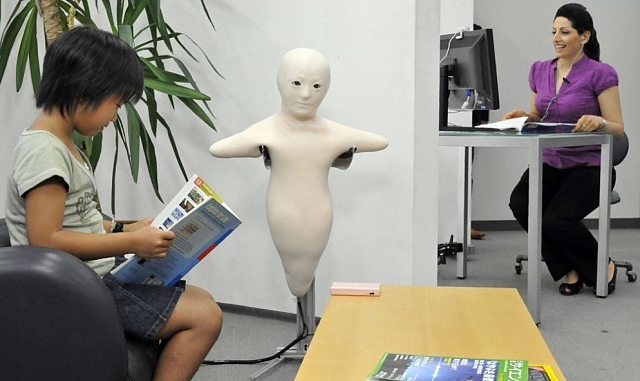
Named "Telenoid R1," the teleoperated communication robot measures 80 centimeters (31 in) tall and weighs 5 kilograms (11 lbs). The portable machine features a soft silicone body that is pleasant to the touch, and it uses 9 actuators to move its eyes, mouth, head and rudimentary limbs.
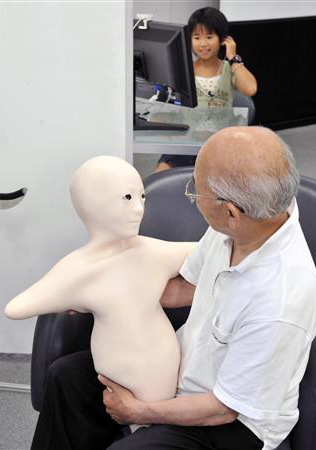
Telenoid humanoid robot --  Telenoid humanoid robot -- Data is transmitted between the user and robot via Internet connection
The Telenoid R1 robot is designed to add an element of realism to long-distance communication by recreating the physical presence of the remote user. The robot's actions mirror those of the remote user, whose movements are monitored by real-time face tracking software on the user's computer. Users can also transmit their voice through the robot's embedded speakers.
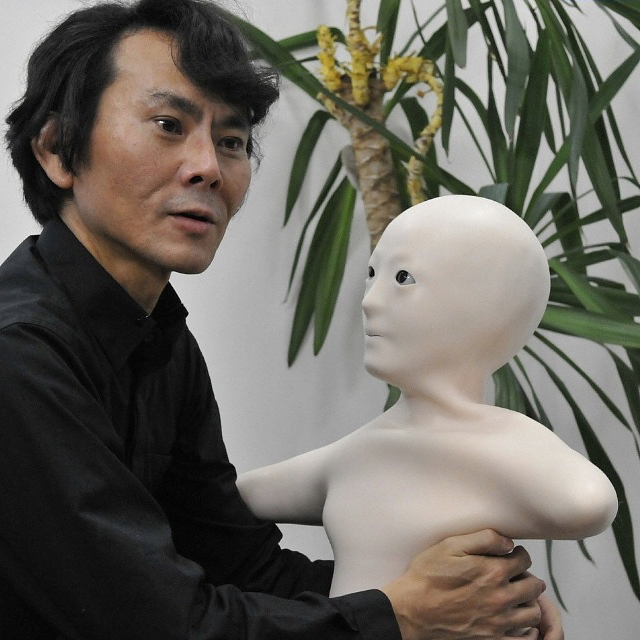
Telenoid humanoid robot -- Telenoid R1 with Dr. Hiroshi Ishiguro (Osaka University)
The Telenoid R1 is endowed with only the most basic human features -- just enough to recreate the physical presence of the remote user, according to robot's creators. The robot's androgynous and ageless look makes it suitable for a wide range of users, whether they are male, female, young or old.
Telenoid humanoid robot -- English lessons can be conducted via the Telenoid R1 robot
At the unveiling in Osaka on August 1, the developers announced plans to begin selling two versions of the minimalist humanoid in October. The high-end model will be priced at about 3 million yen ($35,000), and a cheaper model will be available for about 700,000 yen ($8,000).

Thursday, August 26, 2010

Japan's latest supermodel--a robot


The new Japanese humanoid robot HRP-4C displays a range of emotions (good luck discerning what they are) during a press conference in suburban Tokyo this week. Naturally, plenty of paparazzi were on hand.
(Credit: AFP Photo/Yoshikazu Tsuno)
She doesn't have the grace of a Cindy Crawford or Elle MacPherson (yet), but a few struts on the catwalk may help HRP-4C loosen up and hit her stride. The walking, talking girlbot will be getting practice soon, as she's set to make her catwalk debut at a Tokyo fashion show next week.
Scientists from Japan's National Institute of Advanced Industrial Science and Technology reportedly designed the 5-foot (ish), dark-haired creation to look like an average Japanese woman between the ages of 19 and 29. Unlike the average Japanese woman, however, HRP-4C has 30 motors in her body that allow her to walk and move its arms (somewhat loudly and awkwardly, if the video below is any indication) and 8 facial motors for blinking, smiling, and expressing emotions akin to anger and surprise.
According to the Associated Press, the robotic framework for the HRP-4C, sans face and other coverings, will sell for about $200,000, and the technology behind it will eventually be made public so people can come up their own moves for the bot.
The government-backed AIST says she's mostly being developed for the entertainment industry--for use in amusement parks, for example, or as an exercise teacher--and is not yet ready to help with daily chores. So unfortunately for those eager to hire HRP-4C as a home or office assistant, for now at least, her main job is to look pretty--or odd, depending on your perspective.
Related Posts with Thumbnails